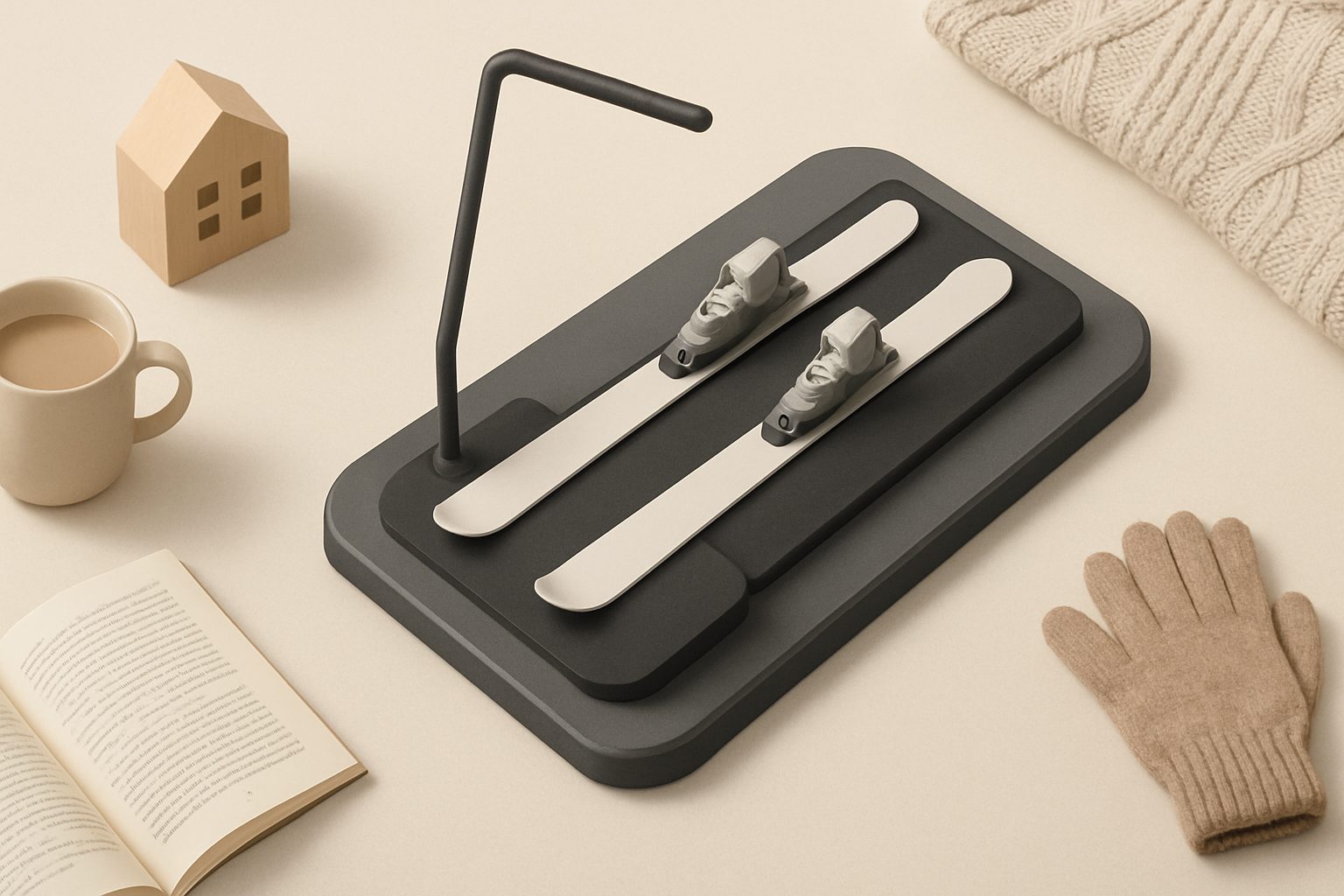
Best Ski Fitness Machines for Apartments & Small Spaces UK
If you're keen to maintain ski fitness through the off-season but live in a flat or small house, you know the space crunch is real. A full-size ski simulator takes up as much room as a spare bedroom—which most of us don't have. The good news is that several genuinely effective ski training machines fit comfortably into tight quarters, and some fold or store almost flat when you're done.
This guide covers kit that actually works for ski-specific conditioning without eating your living room. We've focused on machines under 2 metres in any dimension, with honest talk about what each does well and where it falls short.
Lateral Slide Boards
Lateral slide boards are the space-saving champions. You get a 1.2m × 0.6m platform—basically the size of a yoga mat—and they build explosive lateral power that translates directly to edge control and mogul work.
How they work: you wear friction socks, assume a skiing stance, and slide side-to-side with lateral lunges. It's simple and brutally effective. Your glutes, adductors, and outer quads take the load; your stabiliser muscles work hard to keep you upright.
The honest bit: they're not comfortable the first few times. You will feel the burn quickly, and if you go hard, your legs will complain the next day. They're also repetitive—after about 15 minutes, most people want to stop. You won't build aerobic capacity here; it's pure power and strength.
Cost is low (£60–£150), they pack flat, and a corner of your bedroom handles storage. The main downside is that they need a smooth floor or a mat underneath, and cheap versions develop a slippery surface that becomes gritty after a few months.
Ski-Step Machines
Ski-step machines (sometimes called "ski steppers" or vertical ski trainers) compress a full ski-simulator movement into a footprint of about 1.2m × 0.8m and a height of 1.5–1.8m. They're essentially two foot platforms that slide up and down in a ski-like rhythm while you control the resistance.
These are brilliant if you want cardiovascular work alongside leg strength. Twenty minutes on a ski stepper will elevate your heart rate properly, and the movement pattern is close enough to actual skiing that the muscle memory carries over. You also get a decent glute and quad workout without the awkwardness of a lateral slide board.
Trade-offs: they're more expensive (£300–£800) and they do need floor space. Some models are noisier than others, which matters if you're in a flat above someone else's lounge. They also require a bit more coordination than a slide board—the first session feels clumsy. A few models fold or compact, though not all, so check the specifications before buying.
Compact Ski Trainers
Compact trainers are the in-between option: small enough to fit in a cupboard but more sophisticated than a slide board. They typically have two footrests on a pivoting base, and you move them in a skating or skiing motion against adjustable resistance.
They're quiet, portable, and genuinely fun to use. They work your legs, core, and balance in a way that feels more like skiing than a slide board. The movement also engages stabiliser muscles that you'll thank yourself for when you're carving the Vallee Blanche.
Limitations: they don't deliver the same cardiovascular stimulus as a ski stepper, and the range of motion is smaller. If aerobic capacity is your goal, these alone won't cut it. They're also less intuitive than you'd think on a first go—there's a learning curve to moving smoothly.
Prices range from £150–£500. Quality varies widely; cheap versions feel unstable, and expensive ones aren't necessarily more effective.
Storage & Space Tips
Since you're working with limited space, here's what matters:
Flat-packable options: lateral slide boards win. Most pack to the thickness of a yoga mat and can live in a wardrobe, under a bed, or against a wall. Ski steppers rarely fold fully, though a few newer models claim compact storage.
Vertical footprint: if you're tight on floor space but have ceiling height, a ski stepper works. They're tall and narrow. A slide board is the opposite—it's flat and only takes a cupboard shelf.
Double duty: slide boards can double as a balance mat for yoga or recovery work. Some people keep them out year-round. Steppers are harder to justify as décor.
Flooring: all of these need either a smooth, hard floor (tile, wood, laminate) or a protective mat underneath. Carpet doesn't work. A yoga mat or rubber flooring layer costs £20–£40 and is worth every penny—it protects your floor and reduces noise.
Building a Small-Space Ski Routine
One machine alone rarely gives you everything. Most people combine:
- A lateral slide board for explosive power work (2–3 times per week, 15–20 minutes)
- A ski stepper or compact trainer for cardiovascular maintenance (once or twice per week, 20–30 minutes)
- Running or cycling for base aerobic capacity (this you do outside)
This approach covers strength, sport-specific power, and conditioning without needing a dedicated gym room. A slide board and a compact trainer together occupy less floor space than a sofa.
What Actually Transfers to Skiing
Honest feedback from users: slide boards feel most "ski-like" in terms of power demand. Ski steppers feel most ski-like in terms of movement pattern. Compact trainers are fun but the least specific to actual skiing. In reality, whichever machine you'll use consistently beats the perfect machine you avoid because it's awkward or boring.
Start with a lateral slide board if space is critical and you want pure leg power. Choose a ski stepper if you can spare the footprint and want everything in one machine. Pick a compact trainer if you prioritise ease of storage and don't mind a longer learning curve.
More options
- Lateral Ski Slide Trainers & Ski Simulator Machines (Amazon UK)
- Ski Balance & Rocker Boards (Amazon UK)
- Ski Fitness Slide Boards (Amazon UK)
- Ski Resistance & Plyometric Training Equipment (Amazon UK)
- Protective Floor Mats for Home Gym / Simulator (Amazon UK)