Best Home Ski Simulators Under £1,000 in the UK (2025)
If you're keen to maintain ski fitness between resort trips or improve your balance and leg strength on dry land, a home ski simulator is a smart investment. But "ski simulator" covers a broad spectrum of equipment—from simple balance boards to slide-platform machines—and quality varies wildly. This guide walks through what's actually available under £1,000 on the UK market and what each type delivers.
What counts as a home ski simulator?
Before diving into specific products, it's worth understanding the categories. Most sub-£1,000 options fall into three buckets:
Balance board trainers replicate the side-to-side weight shift of skiing at a fraction of the cost. They're compact and work well for off-season maintenance.
Sliding platforms simulate the forward gliding motion using a board that slides on a low-friction surface. These get closer to actual ski mechanics than balance boards but typically cost more and need more space.
Hybrid systems combine balance and sliding elements, hitting a middle ground between realism and budget.
None of these perfectly replicate skiing—the snow friction, edge bite, and full-body mechanics are missing. But they're proven for building the stabiliser muscles in your ankles and knees, improving proprioception, and keeping your legs sharp when you can't get to the slopes.
Balance board trainers (£200–£400)
The most accessible entry point is a dedicated ski balance board. These are U-shaped or oval platforms that rock side to side, mirroring the edge-switching movement of skiing.
The advantage is simplicity: they're portable, require no power, and can live in a corner of your living room or garage. A quality balance trainer will have a curved, stable base and a non-slip deck surface. Some include guides for stance width and foot positioning, which genuinely helps if you're new to them.
The limitation is obvious—you're not moving forward, and the workout is mostly isometric. You'll feel it in your glutes, quads, and stabiliser muscles, but you're not building the rhythmic edge-change patterns that skiing demands. They work best as a complement to other training, not a standalone solution.
Look for ones with a smooth base that won't scuff your floors and a textured top surface that doesn't feel slippery in socks.
Sliding platforms (£600–£950)
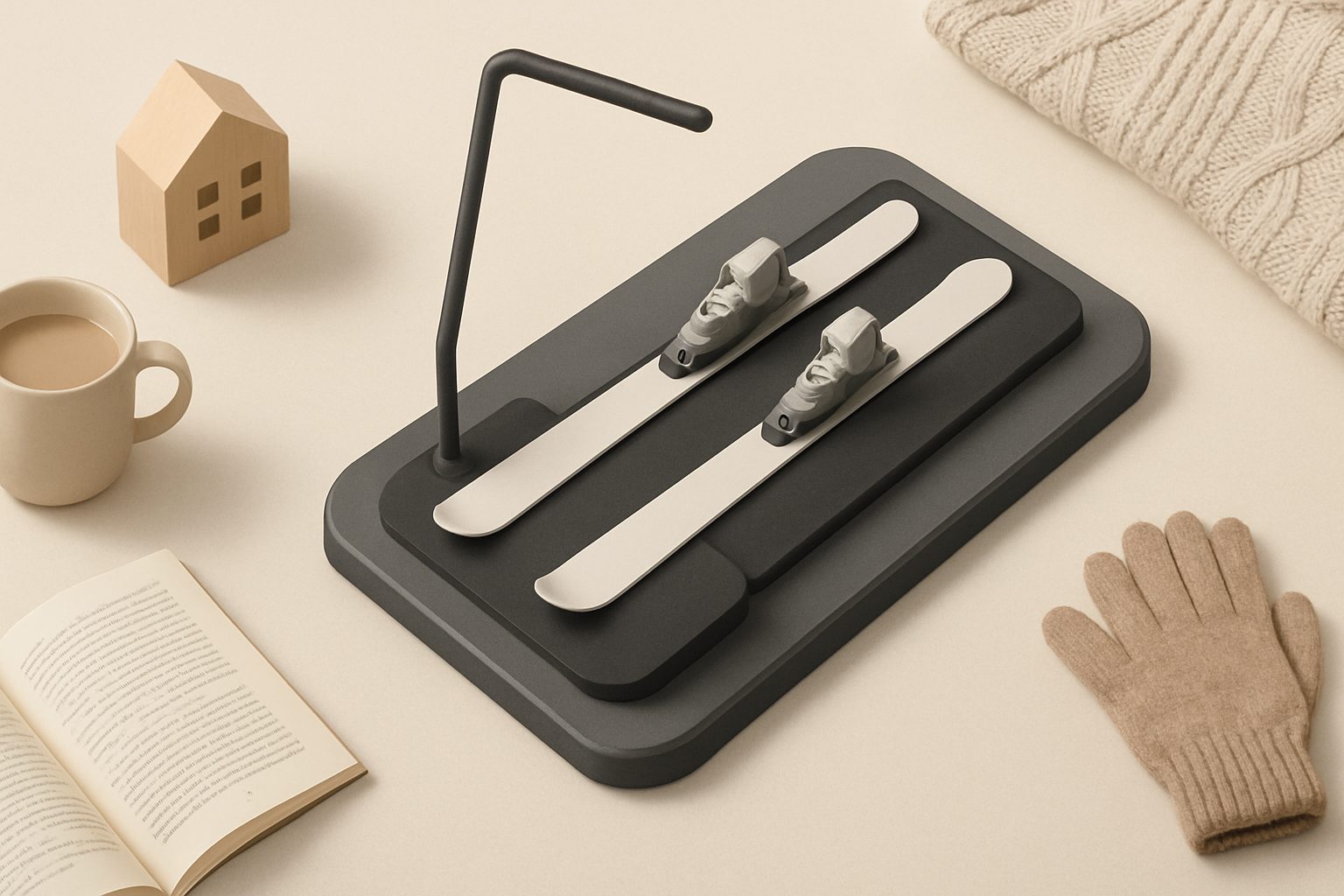
These machines have a horizontal slide board with a front edge you stand against, your feet in booties or with grip socks. You shift your weight side to side, and your body slides across the board—mimicking the gliding phase of a ski turn.
The physics are closer to skiing: you're moving horizontally, managing momentum, and using timing and edge pressure instead of pure balance. Some machines include resistance settings (adjustable friction or spring tension), which lets you ramp up difficulty as you get stronger.
The tradeoff is space and noise. A decent sliding platform needs about 2m × 1m of floor space and can be noisy in a flat. They also require more active setup and takedown than a balance board—though the better ones fold reasonably well.
Quality matters here. Cheap versions have loose slides, uneven friction surfaces, or wobbly frames that defeat the purpose. Mid-range options (around £700–£900) are typically more stable and forgiving for different user sizes.
What to look for when buying
Base stability: The frame shouldn't flex or rattle during use. A heavier platform is often more stable, though it's also harder to move.
Foot security: Whether it's booties, ankle straps, or grip socks, your feet need to feel anchored. Slipping around defeats the training.
Friction surface: For sliding machines, the gliding surface should be smooth and even. Worn or uneven surfaces throw off your balance work.
Adjustability: If the machine has adjustable width or resistance, check that the controls don't get in the way during use.
Reviews from actual skiers: Generic fitness equipment reviews miss skiing-specific feedback. Look for user comments from people who ski.
Budget vs. realism
There's a hard ceiling under £1,000: you won't find anything that replicates moguls, carving at speed, or variable terrain. What you will get is solid training for the movement patterns that skiing requires—balance, edge sensitivity, weight distribution, and rhythm.
If you ski only a few days a year and want to maintain some conditioning, a balance board or mid-range sliding platform is genuinely useful. If you're working on technique between trips—practising rhythm for moguls or carving control—a sliding platform does more. If you're recovering from an injury or building foundational stability, either works.
Reality check
Be honest about how often you'll use it. These machines sit unused in spare rooms more often than not. If you're torn, start with a balance board (they're cheaper and less intimidating) and upgrade later if you're genuinely using it. And don't expect a simulator to replace actual ski days—it won't. Think of it as a supplement to your real training, not a substitute.
The best home ski simulator is the one you'll actually use. Pick something that fits your space, your budget, and your realistic training schedule—and invest in something sturdy enough to last a few seasons.
---
For a deeper breakdown of specific products, techniques, and how to integrate simulator training into your season, see our full home ski training guide.
More options
- Lateral Ski Slide Trainers & Ski Simulator Machines (Amazon UK)
- Ski Balance & Rocker Boards (Amazon UK)
- Ski Fitness Slide Boards (Amazon UK)
- Ski Resistance & Plyometric Training Equipment (Amazon UK)
- Protective Floor Mats for Home Gym / Simulator (Amazon UK)