Indoor Ski Training Equipment for Small Spaces: What You Actually Need
Training for skiing indoors doesn't require a dedicated gymnasium. Most skiers working with limited space can build genuinely effective routines using just two or three pieces of equipment, positioned strategically in a spare bedroom, lounge corner, or even a hallway. The trick is understanding what actually develops ski-specific strength and coordination versus what takes up room and collects dust.
The Core Equipment: What Works in Small Spaces
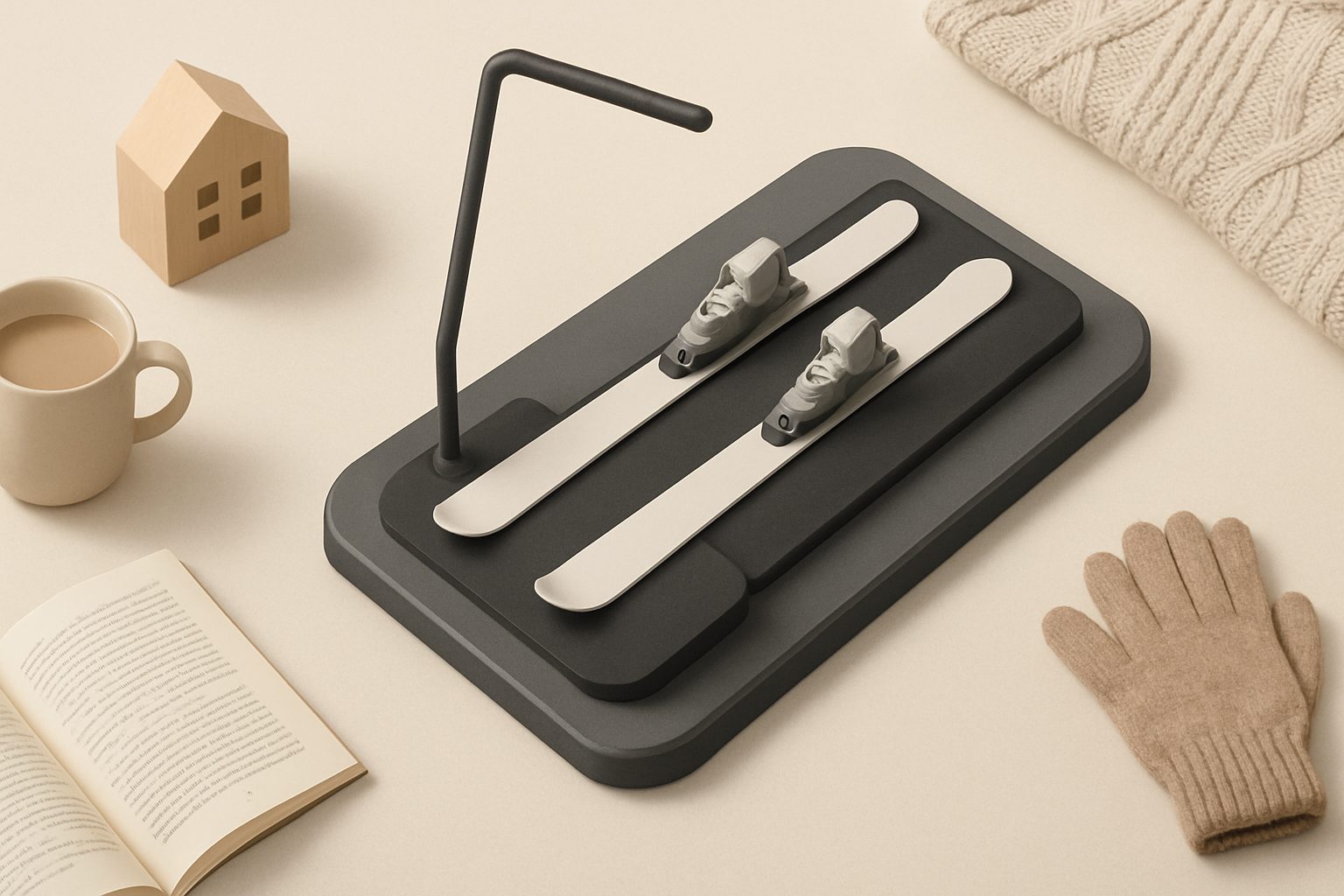
Slide boards are the foundation. A standard slide board is roughly 2.2 metres long by 0.6 metres wide — narrow enough to fit along a wall or under a bed when stored vertically. They simulate the lateral edge-control movements that form the technical core of skiing. You'll push side-to-side in socks or with plastic booties, building the glute medius and adductor strength that prevents injuries on harder snow. A decent board costs £80–150 and requires almost no setup beyond a clear floor section.
Resistance bands (set of 3–4, ranging from light to heavy) take up a drawer and cost £25–40. They're deceptively valuable for rotational core work, single-leg stability, and hip activation — all directly transferable to the mountain. A 1.2-metre square of clear floor is enough for most band exercises.
Balance boards (also called wobble boards or rocker boards) are optional but genuinely useful if you've got a metre-square space. They train proprioception and ankle stability. Good ones are 60–80 cm in diameter and cost £50–100. The foam versions are lighter and can be stored in a cupboard.
Staircase or stepping surface — if you've got stairs, you're set. Single-leg step-ups and lateral bounds on a low step (15–20 cm) develop the eccentric quad strength that prevents knee pain on descents. No purchase needed.
A proper pull-up bar mounted in a doorframe (£30–50) adds upper-body stability work without occupying floor space.
Space-Planning Dimensions
Here's what you're actually working with:
| Equipment | Length | Width | Depth | Storage Volume | |-----------|--------|-------|-------|-----------------| | Slide board | 2.2 m | 0.6 m | 0.05 m | Vertical against wall or under bed | | Resistance band set | — | — | — | Drawer (negligible) | | Balance board | 0.8 m | 0.8 m | 0.15 m | Cupboard shelf | | Step platform (optional) | 0.9 m | 0.45 m | 0.2 m | Under sofa/bed | | Door pull-up bar | 0.8 m | — | 0.1 m | Doorframe (permanent fixture) |
The slide board is your largest footprint, but 2.2 × 0.6 metres is manageable in most homes. You can clear it quickly and store it vertically behind a wardrobe or under a bed. The reality is that your training session doesn't need the space permanently available.
What Actually Works in Small Spaces
Honesty: you won't replicate downhill skiing's eccentric load with dumbbells and bands. But you'll develop the neuromuscular patterns and unilateral strength that matter most for injury prevention and technical improvement. Most ski coaches agree that 60–70% of pre-season fitness is about activating stabiliser muscles and movement quality, not raw power.
A realistic three-times-weekly session in minimal space looks like this:
- 10 minutes on the slide board (lateral shuffles, crossover steps, dynamic weight shifts) — this is your highest-value work
- 15 minutes of resistance band work (lateral walks, resisted rotations, banded single-leg Romanian deadlifts)
- 10 minutes of balance-board or stability work
- Optional: 5 minutes of step-ups if you have stairs
That's 40–45 minutes and requires roughly 3 square metres at peak utilisation. Most weeks, your actual "take up space" time is 15–20 minutes per session.
Real Considerations for Small Spaces
Noise matters. Slide board sessions are quiet, but single-leg jump work isn't. In a flat with carpeted floors, stick to sliding, stepping, and resistance work. Neighbours appreciate it.
Frequency beats intensity in small spaces. You can't load a band heavily enough to build maximal strength alone. Instead, aim for 3–4 sessions weekly, which actually suits small-space training better than two long sessions weekly. Consistency compounds faster.
Video form work is essential. Without space for mirrors or coaching cues, you're flying blind. Use phone video recording — side-on filming of slide board work is particularly valuable for catching imbalances.
Storage must be automatic. If equipment stays out, it becomes clutter. Plan storage during setup, not after. Vertical storage (bands in a drawer, board against a wall, board under the bed) is your friend.
Scaling Up Later
If you're serious about skiing and your space situation changes, a resistance bike or concept2 rower adds value. But neither is necessary to start. Most skiers training in flats or small houses see measurable improvements (fewer injuries, better edge control, faster recovery between runs) within 6–8 weeks using just slide board and bands.
For those investing in apartment-specific setup, see our guide to apartment skiing machines for equipment that doubles as furniture — stationary bikes that double as desk setups, for example.
The key insight is this: your space constraint isn't a training barrier. It's a filter that forces you toward the highest-value exercises. That's actually an advantage.
More options
- Lateral Ski Slide Trainers & Ski Simulator Machines (Amazon UK)
- Ski Balance & Rocker Boards (Amazon UK)
- Ski Fitness Slide Boards (Amazon UK)
- Ski Resistance & Plyometric Training Equipment (Amazon UK)
- Protective Floor Mats for Home Gym / Simulator (Amazon UK)